Wednesday, February 20, 2019

Saturday, February 16, 2019
Is my Company Constitution Tax Effective?

Many will think of the Constitution of their company as a predominantly commercial document setting out the powers and procedures for the making of decisions by directors and shareholders, and the rights attaching to shares in respect of dividends, voting and winding up.
As far as tax is concerned the main focus is to allow for different classes of shares.
However, the content of the Constitution has an impact on the tax results in at least three important ways:
- Super contributions for directors;
- Differential dividends;
- Issue of shares of a different class.
Super Contributions for Company Directors
A tax deduction is generally available for contributions made by an employer for the benefit of an employee.
For a number of years the general view has been that deductions also apply for contributions for directors. A basis for this was that the income tax legislation allowed a deductions for superannuation contributions for persons employed by a company, and the legislation deemed directors to be employed by the company (the additional requirements that they be engaged in producing assessable income or in the business of the company would ordinarily be satisfied in a trading business).
However, were substantially changed in 2007 with the Simpler Super Regime.
The revised requirements for employer contributions run as follows:
- A deduction is available for contributions for employees (directors do not fall within the ordinary meaning of employee);
- Employees are deemed to include those falling within the extended meaning in the Superannuation Guarantee legislation;
- There are also the conditions that the employee be engaged in producing the company’s assessable income or its business, that the fund is a complying fund and the employee satisfies certain age conditions.
The Super Guarantee legislation does not deem any director to be an employee. Rather, it deems a director “who is entitled to payment for the performance of duties as a member of the executive body”.
This means is that a director is not deemed to be an employee unless they are entitled to payment for the performance of duties. The simplest way to provide that entitlement is an appropriate provision in the Company Constitution, for example providing an entitlement of say $1000 per annum. Alternatively, a binding arrangement (preferably, in writing) for the payment of directors fees is required.
Doubts of the correctness of the above analysis were put to rest by the decision in Kelly v FCT (No 2) [2012] FCA 689. A deduction for a superannuation contribution in favour of a director was denied. The court rejected the argument that actual payment of an amount was sufficient. It held that payment and entitlement to payment are different concepts, and entitlement to payment can be provided by the company’s constitution or approval by shareholders in accordance with the Corporations Act 2001.
Differential Dividends
It is quite common for a company to have various classes of shares (although readers should be mindful that the issue a different class of shares can result in the small business CGT concessions not being available on a sale of the business or shares in the company).
The issue of a different class of shares is common where it is desirable to pay dividends to certain shareholders to the exclusion of other shareholders, or at a different rate.
To do so, simply having different class of shares is not enough. If you only have different classes of shares, then all shareholders will be entitled to a share of any dividend declared in accordance with the rights attaching to those shares.
What is necessary is that the Constitution gives the directors the power to pay dividends on a differential basis. A provision of this kind is as follows:
Where there is more than one class of shares on issue, the Directors can declare a dividend so that the dividend:
(a) is made to the holders of shares of any one or more class or classes of shares;
(b) made at a higher, lower or the same rate as the dividend declared on any other class; and
(c) excludes the holders of shares of any other class or classes;
provided that the shares in each class will participate equally in any dividend declared. The resolution which declares a dividend is valid, even if the resolution is passed by virtue of the votes of persons who receive the higher rate of dividend.
Issue of shares of a different class
The issue of shares of a different class may have a number of tax effects including loss of the small business CGT concessions and impact on the utilisation of the losses. In addition, whenever there is an issue of shares the value shifting provisions, debt/equity rules and dividends streaming provisions must be considered.
In respect of the small business CGT concessions, the existence of a Significant Individual is required for the 15 year exemption, retirement exemption and to apply the concessions on a disposal of shares. For there to be a Significant Individual, it must be the case that the relevant shareholder has rights in respect of voting and, importantly, any dividend or distribution of capital.
The reference to the word ‘any’ has the effect that where a shareholder owns shares of one class, but there is another class of shares on issue, a dividend could be paid on the other class with the result that the shareholder does not have rights in respect of any dividend. However, this special rule does not apply to redeemable shares (the ATO accepts this point in Taxation Determination TD 2006/77).
If you are looking to issue shares simply to enable dividends to be paid to a different person, it is preferable for those shares to be issued as redeemable shares. It is also preferable for the rights attaching to those shares to be such that they can be cancelled without tax effect.
Key Points
Special provisions are required for a Company Constitution to be tax effective and to support implementation of tax planning strategies.
Before implementing any of the above arrangements, specific advice should be obtained.
As part of general tax administration, we recommend all accountants undertake a review of their client’s Company Constitutions to ensure their tax planning is not frustrated.
By Domenic Festa
Need advice? Talk to the Tax & Superannuation Team at Rouse Lawyers. Contact us today!
NOTE: This article is for general information only and should not be relied upon without first seeking advice from one of our specialist solicitors.
The post Is my Company Constitution Tax Effective? appeared first on Rouse Lawyers.
Wednesday, January 23, 2019
Are You a Health Care Service Provider? Time to Review Your Privacy Policy

With the My Health Record system expanding, it is time for health care providers to review and update their Privacy Policies. Necessary changes will likely include amendments to how personal information is collected, used and shared.
Notably many Privacy Policies claim they do not share information with any third parties, this may no longer be true if a patient’s information is being uploaded to the My Health Records system. Similarly claims that the provider only collects information from the patient directly, will not be accurate if the provider accesses information from the My Health Record system. Furthermore, the My Health Record Act defines ‘use’ to include accessing, viewing, modifying and deleting information. As such, representations regarding how you use patient’s information may need redefinition.
While it is mandatory for health care providers, who hold health information, to have a compliant Privacy Policy many are falling short of their obligations. Often Privacy Policies are implemented by a web developer when the website is built. These Privacy Policies usually refer to the collection of personal information via the website. However, its far more likely the bulk of the personal information held is derived from sources including, paper forms filled out in waiting rooms, records generated in providing the health services and telephone conversations with patients.
Privacy Policies relate to how businesses deal with personal information from all sources, not just that derived from their websites.
With the notifiable data breach scheme in full force, the last thing you want to do is rush to get compliant during a data breach event before you are required to notify the commissioner.
Get in early, get compliant and avoid the $420,000 maximum penalties.
Michael Barber
Michael is a technology and commercial lawyer with Rouse Lawyers, who advises during data breach events and services clients nationwide with privacy concerns. For assistance with these matters contact mbarber@rouselawyers.com.au or phone (07) 3667 9696.
The post Are You a Health Care Service Provider? Time to Review Your Privacy Policy appeared first on Rouse Lawyers.
Aussiegolfa Appeal: Relief For Grandfathered Trusts?

The Aussiegolfa appeal (Aussiegolfa Pty Ltd (Trustee) v FC of T [2018] FCAFC 122) involved the provision of residential accommodation to a related party of a superannuation fund. Amongst the range of investment rules that apply to superannuation funds, two key issues require consideration for this kind of transaction: the in-house asset rules and the sole purpose test in s 62 and 71 of the Superannuation Industry (Supervision) Act 1993 (SISA). These issues were considered and clarified in the Aussiegolfa appeal.
Brief facts
- 31 March 2015 – SMSF invested in a DomaCom Fund (DCF), a widely held unit trust. The investment comprised less than 1% of the units in DCF.
- DCF allowed the creation of sub funds. At the time of investment, the constitution and product disclosure statements of DCF stated that a sub fund was a separate trust.
- Under the terms of DCF, the investor could nominate a property to be acquired by DCF. SMSF nominated an apartment in a student accommodation complex.
- 21 July 2015 – DCF entered into a contract to acquire the property.
- 23 July 2015 and 17 August 2015, funds held for SMSF’s were applied to the acquisition of units in the sub fund. SMSF and related parties held all of the units in the sub fund. The property was allocated to that sub fund.
- Prior to the creation of the sub fund, the constitution of DCF was amended to provide a sub fund was not a separate trust, but the product disclosure statements continued to make references to a sub fund as a separate trust.
- Investors in a sub fund did not have a direct investment in the underlying property but were entitled to 100% of the net income and proceeds of sale of the underlying property of that sub fund.
- 17 August 2015 – Exclusive management of the property was granted to Student House in Australia (SHA). The first tenancy of the property (from 8 January 2016 for a period of approximately 12 months) and the second tenancy (from 20 February 2017 for a period of approximately 12 months) were granted by SHA to persons not related to SMSF. The third tenant of the property was the daughter of the sole member of SMSF at the same rental and on the same terms as that provided to the first two tenants.
- 3 April 2017 – The sole member stated they were using the Burwood property to test “the related party use of residential property within” self-managed superannuation funds.
- Importantly, the Constitution provided that units in the sub fund had such rights as a responsible entity determines, there was no evidence of any determination of rights attaching to the units in the SMSFs sub fund.
First Instance Decision
In-house asset rules
Pagone J concluded that a sub fund was a separate trust, relying on a statement in the product disclosure statement which described a sub fund as a separate trust and various provisions of the Constitution of DCF.
Sole Purpose Test
Pagone J concluded there was a breach of the sole purpose test since the purpose was to provide residential accommodation to a related party. This was despite the property being provided to the related party on market rental terms. In reaching its decision, the court relied on a statement by the sole member and sole director of the trustee that he wished to test the ability for residential properties held by SMSFs to be used by related parties. A broad view of the decision is that providing housing to a relative would, in itself, cause a breach of the sole purpose test irrespective of the terms of the arrangement.
Concern for grandfathered trusts?
Grandfathered trusts are unit trusts established prior to 11 August 1999 where investments by superannuation funds are either made before 11 August 1999 or under transitional rules that applied until 30 June 2009.
There is no specific provision governing the transactions of grandfathered trusts (unlike ungeared trusts which are governed by Division 13.3 A of the SISA Regulations).
Some grandfathered trusts own residential property either required prior to 11 August 1999, or acquired after that date from realising other property owned prior to that date.
It is often the case that the in-house asset rules do not apply to leases of property by grandfathered trusts and the question is whether a lease of residential property to a related party would cause a breach of the sole purpose test. The view could be taken that where the property is leased on arm’s length terms at market rental, the sole purpose test may not be breached (although all circumstances of the arrangement must be considered). The same may also apply to unrelated trusts (trusts that are not controlled in any of the three ways described in s70E(2) of SISA) at least where the lease to the related party was not contemplated at the time of the investment by a superannuation fund.
The first instance decision in Aussiegolfa would have caused a change in that position on the basis of the broad view that any use of housing by a relative would in itself cause a breach of the sole purpose test.
Aussiegolfa appeal
Following the first instance decision in Aussiegolfa, we expressed the view in an earlier earlier article (see CCH Tax Week Issue 15, 20 April 2018):
- The hurdle for the Aussiegolfa was the in-house asset rules.
- The conclusion on the sole purpose test was reached notwithstanding the court referring to principles that an inquiry into purpose is not an inquiry into motive and where property is used for a permitted purpose, the purpose test is not breached merely because there is an incidental benefit.
- The nature of the property is such that the sole purpose test would not be called into question were it not for use by a related party. It is therefore the case that the property has been used for a permitted purpose, even though there may be an incidental benefit (the use by a related party).
- It is also questionable whether there can be any benefit where property that is a suitable investment for a superannuation fund is provided at market value on commercial terms. The basis for this point is, almost without exception, the cases that found a breach of the sole purpose test involved a financial benefit to a related party.
The decision of the Appeal Court is consistent with the views expressed above.
Appeal Decision
The investment by SMSF in the sub fund constituted an in-house asset because the sub fund was a separate trust. This conclusion was reached because there was an absence of evidence of the rights attaching to the particular class of units, and in the absence of that evidence reliance was placed on the statement in the product disclosure statement that a sub fund was a separate trust as secondary evidence of those rights.
In relation to the sole purpose test, the Appeal Court concluded:
- There is a fundamental distinction between purpose and motive. A motive of providing accommodation to a related party, does not cause a breach of the sole purpose test.
- There is not a breach of the sole purpose test merely because the trustee enters into a transaction with a related party.
- Whilst a tenant of property would obtain a benefit in the sense of obtaining accommodation, where market rent is payable for the accommodation there is no relevant benefit.
- In the absence of a financial or non-incidental benefit, and other facts or matters pointing to a collateral purpose, there is not a breach of the sole purpose test.
- The position would be different if the lease were not at market rent or if the property were not considered a prudent investment for the SMSF and the SMSFs investment policy had been affected by the objective to lease property to the related party.
The decision on appeal is consistent with the views we expressed in our earlier article.
Decision Impact Statement
The ATO issued a draft Decision Impact Statement in respect of the Aussiegolfa appeal on 3 December 2018. The Commissioner considers the decision is limited to certain points of the factual matrix including that the property was initially leased to unrelated parties, the relative paid market rent and there was no suggestion that leasing the property to the relative influenced the SMSF investment policy.
They note it is the purpose of making and maintaining a fund’s investments that is central to the sole purpose test. In this regard the author submits that the sole purpose test requires that a superannuation fund is maintained for the purpose of providing retirement and death benefits as well as permitted ancillary purposes, and there is a range of investments that may achieve that purpose. A superannuation fund can satisfy that purpose notwithstanding that the trustee has the motive of acquiring investments that suit the requirements of related parties. In accordance with Aussiegolfa, such an investment would not cause a breach of the sole purpose test provided any use by related parties is on market value terms, and the investment is otherwise a prudent investment for a superannuation fund.
The ATO take a contrary view. They consider that the case is not authority for the proposition that there is no breach of the sole purpose test when market value rent is charged. That is clearly correct, the charging of market rent does not overcome the sole purpose test if there are ancillary rights attached to the investment (e.g. club membership) or the investment is not prudent, for example, a beach house used by related parties during the Christmas period each year but in a location that does not attract tenants for the remainder of the year.
The ATO conclude with the position that a super fund will contravene the sole purpose test if the fund acquires residential premises for the collateral purpose of leasing to an associate, even if the associate pays rent at market value. The author considers this position is contrary to the Aussiegolfa appeal. The reference to collateral purpose is in fact the motive of the investment and is in accordance with the decision of the primary judge which was overturned on appeal. If the ATO were right, the acquisition of business premises for use in a related party’s business would contravene the sole purpose test, which is clearly not the case in the absence of other factors described in the Aussiegolfa appeal.
Conclusion
The first instance decision would have caused concerns for residential property owned by grandfathered an unrelated trusts. The simple lease of residential property to a related party, irrespective of the terms, may have caused a breach of the sole purpose test.
The appeal court, in the author’s view, brings matters back to what existed before the first instance decision – namely the focus of the sole purpose test is on whether there is the provision of a financial benefit that is not in accordance with the core or ancillary purposes.
With proper implementation of arrangements, grandfathered and unrelated trusts are not subject to the same investment restrictions as apply to superannuation funds, and transactions can be entered into with related parties without breaching the sole purpose test.
Financial Benefit cases:
Driclad Pty Limited v Commissioner of Taxation (Cth) (1968) 121 CLR 45
Raymor Contractors Pty Ltd v Federal Commissioner of Taxation (1991) 21 ATR 1410 (Davies, Wilcox and Hill JJ) and Cameron Brae Pty Ltd v Commissioner of Taxation (2007) 161 FCR 468 (Stone, Allsop a
See also iKnow: Home » Practice Areas » Superannuation » Commentary » Annotated commentary » SUPERANNUATION INDUSTRY SUPERVISION Fund Operations » Compliance with sole purpose test
By Domenic Festa
The post Aussiegolfa Appeal: Relief For Grandfathered Trusts? appeared first on Rouse Lawyers.
10 Ways to Ruin a Deal

1.Dive in unprepared.
- Making an offer before you understand the business and structure of the seller.
- Making an offer before you have undertaken proper due diligence.
- Not seeking professional advisors before you intend to enter a transaction.
2. Appoint the wrong advisors or appoint the right ones too late.
- Accountant
- Lawyers
- Business broker / corporate advisor
3. Fail to address tax and structuring issues from the outset.
- CGT
- Stamp duty
- Risks for buyer and seller entities
- Guarantees / warranties
- Limit of liability
4. Forget about working capital.
- Commonly misunderstood. Most share sales have a working capital adjustment and a level of cash and receivables are left in the business.
- In an asset sale, parties often reach agreement, but working capital is not addressed. When a buyer realises he needs another $500,000 to operate the business, the deal may fall over.
5. Jump to formal agreements when a term sheet might save time and money by ensuring parties are on the same page on key issues before diving into the detail.
6. Understand whether you can get along with the seller or buyer post settlement.
7. Fail to consider vendor finance and appropriate securities (and if seller is the ‘bank’ and you are working with them it can be uncomfortable).
8. Announce a sale too early
- To Staff
- To Suppliers
- To the Market
9. Ask due diligence questions too late and then ask for adjustments.
10. Competitor paranoia complex. Over thinking/assuming the buyer is just looking under your hood.
By Matthew Rouse
The post 10 Ways to Ruin a Deal appeared first on Rouse Lawyers.
Tuesday, December 4, 2018
Tis The Season to be Jolly…But Not Too Jolly At Your End of Year Work Functions

Whilst the end of year work function is a great time for your team and business to celebrate your successes for the year, remember that your function needs to run as a ‘work’ function, without breaching your workplace health and safety obligations, your Human Resources policies and other legal obligations that your business must comply with.
Businesses should take steps to minimise the risks at your end of year functions and educate employees about the expected standards of behaviour at such functions and have some key steps in place to prevent any issues from arising, or if they do, to properly manage them to avoid issues, claims and litigation and starting your New Year off with the wrong kind of bang!
If employees become intoxicated at your end of year function or engage in inappropriate or unruly behaviour, your business should have a plan in place to deal with that.
Remember that, as the employer, your business can be held vicariously liable for the conduct, or rather misconduct, of your employees, even at your end of year work functions that are off site and outside of normal business hours. It is therefore a good risk management practice to remind your employees of their obligations, whilst of course still encouraging them to celebrate their successes for the year and have a good time, but that this is a balancing act for everyone attending.
What should your business be doing to prepare for your end of year work function?
Before end of year functions
-
Make sure that your business has the necessary Human Resources policies in place to address issues that may occur at end of year functions, such as a Code of Conduct and relevant policies, including on workplace bullying, sexual harassment and discrimination and that these are current and up to date and available to employees.
-
Make sure your Managers, Supervisors and Team Leaders are aware of and know that they are expected to model your relevant Human Resources policies at your end of year function.
-
Nominate key Managers, Supervisors and/or Team Leaders to discretely supervise at the function and give them clear authority to act if they see inappropriate or unruly behaviour – for example, arranging to cease serving alcohol to an intoxicated employee, to having a discrete discussion with an intoxicated or unruly employee to leave and assist in getting them home safely, e.g. ordering and escorting them to a taxi.
-
Make sure that your business sends out a clear email message prior to any end of year work functions – to set the expectations of employees regarding their conduct and behaviour at the function – and that your Human Resources policies still apply at your end of year function and that employees are expected to comply and behave appropriately and within the normal boundaries expected at work whilst they attend end of year functions. Also prompt them make appropriate arrangements to get home safely at the end of the function.
-
Whilst there is no specific obligation to provide transport home to employees after your end of year function, you should take active steps to minimise the risk of injury to your employees by specifying the clear rules that apply at your function, arranging for their safe travel home, and if anyone requires assistance in getting home, have designated personnel at the function to assist in arranging taxis for employees.
-
Make it clear that any post-function activities or after parties are on an employee’s own time and at their own responsibility.
At the end of year function
- Set clear start and finish times for your end of year function.
- Take steps to ensure that there is responsible service and consumption of alcohol and sufficient food and non-alcoholic drinks for employees to enjoy at the function. Place limits on the supply of alcohol if necessary.
- Ensure your designated Managers, Supervisors and Team Leaders work to prevent excessive drinking and inappropriate or unruly behaviour.
- Utilise taxis to ensure everyone leaves the function safely and can head home safely after the function.
What if something goes wrong?
-
Act quickly and discretely:
-
If an employee is too intoxicated, send them home in a taxi straight away;
-
-
-
If your Managers, Supervisors and/or Team Leaders become aware of inappropriate or unruly behaviour they should take immediate steps to stop the behaviour.
-
-
Make sure your Human Resources policies are adhered to carefully. If an investigation needs to be conducted after the end of year function, make sure this occurs.
-
Finalise any investigation and implement any disciplinary action required in accordance with your business procedures.
If your business follows the above steps, your business and your employees should be able to enjoy a successful and incident free end of year function and your business can start the New Year off with the right kind of bang!
In the event you need assistance to prepare for your end of year function, or dealing with an incident that occurs, Rouse Lawyers is experienced in providing responsive legal advice to manage such functions, and any incidents and investigations to navigate and minimise the risks to your business.
The post Tis The Season to be Jolly…But Not Too Jolly At Your End of Year Work Functions appeared first on Rouse Lawyers.
Wednesday, November 14, 2018
Gift Card Laws to Change

Gift cards: the backup when you’re fresh out of ideas for that person who has everything.
Remember that time you excitedly went to cash in grandma’s birthday present, only to find you were a week too late? Well, this dilemma is soon to change.
The federal government have introduced new regulations that will require gift cards and vouchers to have a minimum expiry period of 3 years. The expiry date on the gift card will need to be prominently displayed. Certain post-supply administration fees will also be banned.
This change to the Australian Consumer Law will apply nation-wide and provide consistency for consumers, with some states such as New South Wales having already introduced similar laws. Failure to comply with the new laws will risk a fine.
The new regulations will take effect on 1 November 2019 and apply to gift cards sold from that date. Businesses selling gift cards and vouchers outside of New South Wales therefore still have time to prepare for these changes.
Unfortunately the regulations won’t apply to existing gift cards, so be sure to spend this year’s haul of Christmas presents by the expiry date on the card.
The post Gift Card Laws to Change appeared first on Rouse Lawyers.
Thursday, November 8, 2018
What is a “Make-good”?

Many tenants under retail or commercial leases don’t realise the extent of their obligations once their lease comes to an end. De-fits and make-goods can be costly, so knowing your obligations before you sign your lease is key.
Make-good or de-fit?
Most leases say that once the lease ends, the tenant must leave the leased premises in a certain state.
There are many different terms that can be used, including ‘de-fit’, ‘make-good’, ‘refurbish’ or ‘redecorate’. The lease will detail exactly what needs to be done. This can include one or more of the following:
- Leaving the premises clean, tidy and in good repair.
- The removal of your fixtures, fittings, signage and equipment.
- Repainting the premises and replacing floor coverings.
- Reconfiguring the premises to its original layout.
- Stripping the premises back to a bare base-shell.
Even if you’ve installed a $100,000 fit-out in excellent condition, you may still be required to remove it.
Landlords may sometimes allow you to leave the premises as-is, but this is not common and unless the lease says otherwise, it’s the landlord’s choice to make. They may be willing to grant you this concession if they believe the current fit-out is in good condition and would be a selling point to secure a new tenant. However, even though you may consider your fit-out to add value to the premises, a new tenant may want a different look and layout. This is especially so if the use of the premises may change, for example, from a café to a clothing store.
Some landlords may be willing to accept a predetermined de-fit fee and handle the works themselves, saving you from carrying out the de-fit yourself. This should be discussed well in advance though.
Plan ahead
It’s essential to engage a solicitor to negotiate your lease before you sign it. Leases are always up for negotiation and a reasonable compromise can often be reached. Consider the following:
- The lease may require a ‘bare shell’ state. This could instead be changed to be the same state as back when the lease started. That means you would only need to re-alter any changes you’ve made during your time as tenant, saving you from removing anything installed before your lease started.
- Leases often refer to returning things to their ‘original condition’. Your interpretation of ‘original’ may be the condition when your lease started, but the landlord may consider it to mean before a previous tenant took over. For example, the landlord may expect you to remove the kitchen installed by the former tenant who you bought the business from. You should clarify the meaning of ‘original’ in the lease.
- Did the landlord give you a fit-out contribution when your lease began? You may wish to ask that your make-good won’t extend to removing anything the landlord paid for.
- Avoid the landlord having a broad discretion to direct you to do ‘any’ works they require. Try to narrow this down to a particular list of things.
- It’s good practice for you to take photos and make a written record of the state of the premises before or when your lease started. That can save an argument in the future about whether a door or wall was there or not.
Consequences of not complying
Failing to comply with your make-good obligations will entitle the landlord to a number of different options depending on your lease. These can include the landlord:
- being entitled to treat anything left in the premises as abandoned, meaning they become the owner;
- doing the make-good themselves and sending you the bill (and then suing you and any guarantors if the bill isn’t paid); and/or
- continuing to charge you rent until the make-good is complete to their satisfaction.
Always remember the security bond or bank guarantee that you gave the landlord when you signed the lease. Leases often say that landlords only need to give this back once the lease ends and they are satisfied with your make-good. If you fail to do your make-good then the landlord could apply your security towards doing it themselves.
What if you’re a franchisee?
If you’re a franchisee then you have an extra set of considerations to take into account.
Franchisees often assume that their franchisor will purchase their business at the expiry of the franchise agreement and take over the lease, or pay the franchisee for their fixtures. A franchisor has no obligation to do this, unless expressly stated in the franchise agreement.
We often hear franchisees say “the franchisor will not want this shop to close – they will pay for our equipment”. Then, franchisees discover that the franchisor does not want the shop. A franchisee should take this into account before deciding not to renew a franchise. Rarely will a franchisor pay market value for a business including a goodwill component. They may pay either the written down value for the equipment or market value but that will not be much. Equipment that cost a lot to install (in some cases hundreds of thousands) may only bring $5,000 when valued as second-hand equipment.
Some franchisees may be lucky and have a franchisor willing to purchase their business, take over their lease or perhaps purchase their second-hand equipment at its market value, saving the obligation to de-fit and make-good the premises.
If the franchisor doesn’t elect to do this, then your franchise agreement will generally require you to de-badge your premises when the agreement ends. That means all identifying features unique to the franchise system must go. Even though your landlord may be fine with you leaving the premises as-is, your franchisor may require the colour scheme, fit-out, and even layout, to be changed.
Takeaways
A de-fit and make-good can be expensive, therefore a little thought and planning at the right time is essential.
By Luke McKavanagh
The post What is a “Make-good”? appeared first on Rouse Lawyers.
Trust Splitting: Opportunities Remain!

On occasions, it is desirable to restructure the assets of a trust. The motivations for a restructure can include: succession planning, separating control of certain assets to different persons, separating passive investments from business activities, and separating different businesses.
For Queensland practitioners, these restructures can be implemented without triggering stamp duty by implementation in accordance with a particular process that is not covered by the dutiable categories.
The sticking point is CGT. Until 31 October 2008, a trust cloning exception existed in CGT events E1 and E2 where the terms and beneficiaries of each of the trust were the same.
After 31 October 2008, an alternative often contemplated was through a process of trust splitting, which on a basic level involves appointing a separate trustee for certain identified assets of the main trust. Such a process would be effective for CGT purposes provided the trust split did not cause the creation of a new trust in respect of the assets held by the separate trustee.
Of itself, a trust split does not have the same effect as trust cloning prior to November 2008 since a trust split simply involves having separate trustees of one trust, whereas a trust clone resulted in a separate trust.
Some practitioners implemented additional steps – excluding beneficiaries in respect of the split assets, limiting the right of indemnity of each trustee to the assets held by that trustee, and placing the power to change trustees in respect of the split assets in a different person. These additional steps raise the question of whether the split trust caused the creation of a new trust.
The issue is considered in the ATO’s draft Taxation Determination TD 2018/D3. It concludes that an arrangement that displays certain factors are considered by the ATO to result in the creation of a new trust. In our view, the key factors identified by the ATO are:
- the existing trustee is removed as trustee of certain assets and a new trustee appointed to hold those assets;
- control of the original trustee resides with certain beneficiaries, and the new trustee is controlled by other beneficiaries;
- different appointors for each trustee;
- the trustee’s right of indemnity is limited to the assets held by each trustee;
- distributions are limited to a subset of beneficiaries associated with the controller.
Various trust splitting arrangements can be implemented without incorporating these factors. In particular, arrangements separating passive investments from business activities and different businesses would only require factor number 1.
Case Study
Joe Ryan as the sole director and shareholder of Ryan Pty Ltd, the trustee for the Ryan Family Trust. The trust fund of the Trust includes a substantial professional services business, and a passive investment portfolio. Joe wishes to change the trust arrangements by placing the ownership and operation of the professional services business in a separate trustee company. Joe establishes Ryan Services Pty Ltd, removes Ryan Pty Ltd as trustee of the professional services business, and appoints Ryan Services Pty Ltd as trustee for that business. These changes are not covered by the draft tax determination and are not considered to create a new trust. In addition, if the indemnity of Ryan Services Pty Ltd were limited to the services business (where legally permitted), we also consider the arrangement is not covered by the draft tax determination.
Takeaway
The draft tax determination is limited in its terms to trust splitting arrangements evidencing particular features. Opportunities remain to implement trust splitting arrangements that are not covered by the draft tax determination.
Nevertheless, trust splitting involves appointing separate trustees of a single trust. For that reason, we consider trust splitting arrangements should be a last resort option and other available alternatives should be canvassed.
By Domenic Festa (Accredited Tax Specialist and Chartered Tax Adviser)
NOTE: This article is for general information only and should not be relied upon without first seeking advice from one of our specialist solicitors.
The post Trust Splitting: Opportunities Remain! appeared first on Rouse Lawyers.
Trust Splitting: Better Alternatives For Consideration

Trust splitting is a process that involves appointing a separate trustee for certain identified assets of a single trust. The purpose of a trust split is to separate the control and legal ownership of assets into separate trustees. The reasons for implementation include: succession planning, separating control of certain assets to different persons, separating passive investments from business activities, and separating different businesses.
They are viewed by some as a replacement for the trust cloning exception that existed until 31 October 2008. However, a significant disadvantage is irrespective of the number of separate trustees, there is a single trust – therefore it does not deliver the same benefits as a trust clone.
Some advisers had attempted to introduce additional steps into trust splitting to produce the same effect as a separate cloned trust. After the release of TD 2018/D3, all forms of trust splitting may be subject to challenge either because they are covered by the draft determination or by the application of what the ATO considers to be the law under its revised interpretation.
There are a number of alternatives for dealing with trust assets.
Trust Restructures
For Queensland clients, restructures can be implemented without triggering stamp duty by using a particular process that is not covered by the dutiable categories. Importantly, it does not require a clone with the same terms and beneficiaries, but merely a commonality of trust interests. It also allows a restructure from one type of trust into a different type of trust e.g. from a unit trust to a discretionary trust or a superannuation fund, and vice versa.
It is therefore possible to restructure trust assets into a different trust without stamp duty, and CGT can be addressed if eligible for one of the following alternatives:
- Fixed/Unit Trusts – utilising the CGT rollover, if eligible, under subdivision 126-G.
- No capital gain/sufficient available losses – despite a CGT event occurring, no tax liability will arise if there is no capital gain or any gain is offset by capital or revenue losses.
- Small business CGT concessions – these concessions require satisfaction of active asset conditions and either $2 million turnover or $6 million maximum net asset value test requirements. If eligible, they can allow a restructure of a trust asset without tax and provide a market value cost base to the new trust.
- Small business restructure rollover – this rollover is available for entities with active assets associated with small businesses with turnover of up to $10 million. It is a true rollover with the cost base of the new trust being the same as the existing trust (there is no upgrade as occurs under the Small business CGT concessions).
Family Splitting Arrangement
This is an alternative that provides much of the benefits of a trust restructure without triggering any CGT or duty events. It can be used to transfer the control among beneficiaries, or alternatively to separate the risk attached to each particular asset.
This alternative has the following elements:
- New entities (companies or trusts) are established as required:
- The current controllers can retain control over the existing trust and the new entities. Alternatively, they can pass control of the new entities to the separate beneficiaries at any time they choose;
- Current equity in the relevant asset is transferred to the identified new entity;
- The new entity takes a registered security interest over the relevant asset, providing it with control in respect of disposal of the asset;
- The new entity is provided with use and enjoyment of the asset;
- Protections are included to provide the new entity with future increases in the equity value of the relevant asset;
- Does not require the triggering of any CGT or duty event until the new entity requests the disposal of the asset.
The process allows a separation of trust assets not provided for by trust splitting, and done in a manner that does not trigger any CGT or duty events.
Case Study
Bruce Green as the sole director and shareholder of Green Pty Ltd, the trustee for the Green Family Trust. The trust fund of the Trust includes a substantial trading business, and a real estate portfolio. Bruce wishes to change the trust arrangements regarding the ownership and operation of the trading business in a separate trust. Bruce establishes Green Services Pty Ltd which is to act as trustee for the Green Business Trust. The Family Splitting Arrangement is implemented resulting in the future conduct of the business being operated by the trustee of the Green Business Trust, which is separate from the Green Family Trust. No CGT or duty events are triggered on the transaction.
Please contact one of our team for the options available to assist with trust rearrangements and trust succession.
By Domenic Festa (Accredited Tax Specialist and Chartered Tax Adviser)
NOTE: This article is for general information only and should not be relied upon without first seeking advice from one of our specialist solicitors.
The post Trust Splitting: Better Alternatives For Consideration appeared first on Rouse Lawyers.
ATO Attack on Stapled Structures: Does it Affect Private Business

The ATO has had on its radar what it describes as stapled structures. It has identified a number of concerns that it has with stapled structures. Then in the May 2018 budget, the Government announced amendments to the law to address some of the concerns.
In its Taxpayer Alert (TA 2017/1: Re-characterisation of income from trading businesses), the ATO identified four different kinds stapled structure arrangements. Each of those have similarities to structures that are commonly implemented by private business.
This article considers whether the ATO concerns apply to private business.
The kinds of staples identified by the ATO (in order of relevance to the private business) are: Royalty Staple, Rental Staple, Finance Staple, and Synthetic Equity Staple.
Further details in respect of each of the staple arrangements, and how they are similar to private business structures are:
Royalty Staple
Key Features:
- Asset Trust holds assets such as intellectual property, industrial equipment, or other assets of a busines
- Operating Entity pays a royalty to Asset Trust for use of the assets
- Operating Entity claims a tax deduction for the payments made to Asset Trust

Rental Staple
Key Features:
- Asset Trust owns land and fixtures on land (e.g. business premises)
- Operating Entity enters into one or more lease agreements with Asset Trust for lease of the premises
- Operating Entity claims a tax deduction for the payments made to Asset Trust

Finance Staple
Key Features:
- Operating Entity carries on a business usually with external debt
- Operating Entity carries much less than the expected level of equity
- Asset Trust receives trust equity from the investors as beneficiaries
- Asset Trust’s equity is lent to Operating Entity at interest
- Operating Entity claims a tax deduction for the interest payments
- The interest is usually distributed to the investors

Synthetic Equity Staple
Key Features:
- Asset Trust and Operating Entity enter into an arrangement under which the Operating Entity pays:
- profit-equivalent amounts to Asset Trust-
- turnover-equivalent amounts to Asset Trust, and/or
- amounts which have a similar result as the above.
- Operating Entity claims a tax deduction for the payments made to Asset Trust

Each of the above staples have some equivalents to structures ordinarily implemented by private business entities as follows:
- Royalty Staple – License arrangements for a business;
- Rental Staple – lease of business premises;
- Finance Staple -inter-entity loans;
- Synthetic Equity Staple – license arrangements and certain kinds of joint venture agreements.
However, it seems clear from the Alert that the ATO’s key concern is where stapled structures are used with foreign investors, and the stapled structure converts income that would have otherwise been trading income in a corporate entity into more concessionally taxed passive income derived by a trust (in particular, an MIT). For foreign investors, trading income in a corporate entity is taxed as fully franked dividends at 30%, but passive income flowing through a trust is taxed at much lower rates applying to interest and royalties. Their main focus of attack is that the trust is not an MIT but rather taxed as a public trading trust, which prevents income from being concessional passive income.
Effect on Private Business Structures
Most private business structures are owned and controlled by Australian residents. The issue of concern with the ATO of the tax benefits to foreign investors from stapled structures do not arise for Australian residents in private business entities.
The ATO acknowledges that traditional stapled structures have been used in the tax system for many years and are accepted where they do not exhibit the above issues involving foreign investors.
However, they also note that stapled structures of the ordinary kind have general tax compliance issues to satisfy in their implementation. It is therefore necessary to ensure proper implementation with effective documentation.
By Domenic Festa (Accredited Tax Specialist and Chartered Tax Adviser)
NOTE: This article is for general information only and should not be relied upon without first seeking advice from one of our specialist solicitors.
The post ATO Attack on Stapled Structures: Does it Affect Private Business appeared first on Rouse Lawyers.
Wednesday, October 24, 2018
Effect of Trust Vesting Date: ATO Confirms Our Long-Held View!

Most trusts, and all private discretionary trusts, have what is known as a vesting date which is described differently in different trust deeds e.g. Vesting Date, Perpetuity Date, Termination Date, Vesting Day. The question often asked is what happens when that day is reached? This issue is considered by the ATO in Taxation Ruling TR 2018/6 Income tax: trust vesting – consequences of a trust vesting.
The Issue
Many practitioners believe that on reaching that day the trust comes to an end and essentially requires a winding up process: realise such of the assets as are necessary to pay out liabilities, pay liabilities, and transfer the surplus assets are those that are entitled. In private discretionary trusts, the trustee will have a discretion to nominate which of the beneficiaries are entitled to surplus.
Clearly this is an issue for many practitioners, resulting in the ATO issuing a public ruling.
The concern is that the sale of assets and transfer of surplus assets to beneficiaries will trigger liabilities for capital gains tax and stamp duty, based on the market value of the assets at the time of the transfer. Bearing in mind the perpetuity period is often 80 years, these liabilities can be significant.
This belief arises because it is generally understood that the life of a trust is limited by a perpetuity period (often set as a period of 80 years prescribed by statute), and at the end of that period the trust must come to an end.
Legal Concept
The concept of a perpetuity period is founded in what is described as the ‘rule against perpetuities’. That rule is described in Jacobs’ Law of Trusts in Australia 8th edition in the following way:
In its modern formulation, as stated in Cadell v Palmer, it provided that an interest in property if not vested at the time of its creation, must vest [within the perpetuity period]; if there was merely a possibility that this might not occur, the disposition was void. It will be observed that the rule is not strictly a rule against perpetuities, but against remoteness of vesting.
Solution
The writer has always taken the view that the rule requires that the interests in the trust become fixed, with proper processes the trust does not come to an end, and a trust may exist in perpetuity provided it vests (with fixed interests in nominated beneficiaries) within the perpetuity period. The result is that with proper processes capital gains tax and stamp duty liabilities can be avoided on the vesting date.
Capital Gains Tax – relevant CGT events for consideration are CGT events A1, E1, E5 and E7. By adopting the proper process, there is no transfer of assets, beneficiaries do not become absolutely entitled to the assets, and the other CGT events will not apply.
Transfer (Stamp) Duty – this applies if there is a transfer of dutiable property or a change of trust interests. By adopting the proper process there will be no transfer or such a change.
In Taxation Ruling TR 2018/6, the ATO considers the income tax consequences of reaching the vesting date. Consistent with our view above, the ATO states in paragraph 13:
The vesting of beneficial interests in a trust, even if described as a ‘Termination Date’, does not ordinarily cause the trust to come to an end, nor cause a new trust to arise. Vesting does not mean trust property must be transferred to the takers on vesting on the vesting date, or that the trust must be wound up either immediately or within a reasonable period (although the deed may require these events to occur after vesting).
Upon the vesting of a discretionary trust, the interests of entitled beneficiaries become fixed, and the trust converts from a discretionary trust to a fixed trust. Various restructures of either the trust assets or the vested interests may be considered which do not trigger liabilities for capital gains tax and/or stamp duty.
Takeaway
When considering these issues it is prudent to use advisers that are fully aware of the legal ramifications, and do not need to wait for ATO guidance.
NOTE: This article is for general information only and should not be relied upon without first seeking advice from one of our specialist solicitors.
Contact one of our specialist solicitors to address your trust vesting issues.
By Domenic Festa (Accredited Tax Specialist and Chartered Tax Adviser)
The post Effect of Trust Vesting Date: ATO Confirms Our Long-Held View! appeared first on Rouse Lawyers.
PPSR Renewals – The Clock is Ticking!

Take note that from 30 January 2019 security interests registered for 7 years will begin to expire.
After its commencement in January 2012 many businesses registered security interests on the Personal Property Securities Register (PPSR) with a 7 year renewal option. Nearly 7 years has passed since registrations on the PPSR commenced and they are about to start expiring.
Don’t Delay!
Once a registered security interest expires it can no longer be renewed. Therefore, it is imperative that renewals are commenced in a timely manner and sooner rather than later. You can, and should, extend your PPSR registration ahead of time.
If your security interest lapses and you register the interest again you run the risk of losing the protection that you may have enjoyed had the security interest been renewed, for example:
- Subject to exceptions, due to the first-in-time approach of the priority rules for enforcing security interests, if your business allows its PPSR registrations to expire so that a new security interest needs to be registered on the PPSR then, unless an exception applies, your business will go to the back of the security interest enforcement line. This means that you may miss out on money owed to your business in the event you need to rely on the security interest.
- If the business granting your business the security interest becomes insolvent within 6 months of the security interest being re-registered after it has lapsed your security interest may not be effective. Again, you may miss out on money owed to your business.
Where to Begin?
Identify what security interests you have registered on the PPSR and when they expire. Diaries the expiry date and set a reminder well in advance of expiry to renew the registration. Check all the information is correct and seek assistance if in doubt.
Takeaways
The first 7 year PPSR registrations are coming up for renewal from 30 January 2019.
Renew your PPSR registrations well in advance of expiry prevent the security interest lapsing and losing protection for your business.
Take steps not to miss your renewal deadlines by identifying expiry dates and setting renewal reminders well ahead of the renewal deadline.
It is likely to be a busy time for renewals so don’t delay!
By Sonja van der Steen
The post PPSR Renewals – The Clock is Ticking! appeared first on Rouse Lawyers.
Wednesday, October 10, 2018
Why Businesses Can’t Be Too Casual About Their Casual Employees

There has been quite a bit happening with regards to casual employees of late that businesses should take stock and review all casual employment arrangements they currently have in place.
Whilst casual employees are not entitled to annual leave under the National Employment Standards (NES) in the Fair Work Act 2009 (Cth) (FW Act), the recent Full Federal Court decision of WorkPac Pty Ltd v Skene [2018] FCAFC 131 (the Skene decision) has looked closely at when an employee is really a casual for the purposes of the NES and therefore entitled to annual leave. We recommend that all businesses now take stock and do the same, considering whether their casual employees really are casual employees.
In the Skene decision, the employee, fly in fly out worker, was placed on a roster which was set 12 months in advance. He worked regular, fixed shifts and was paid a flat hourly rate, with no separately identifiable casual loading. When he was terminated, the employee argued that he was a permanent, not a casual, employee, and therefore entitled to be paid out annual leave on the termination of his employment.
The Court closely reviewed the true nature of the employment relationship in the Skene decision. They found that the employee had no choices with regards to the days and hours he could work and that his roster was set 12 months in advance, meaning his working arrangements were clear and predictable and he worked regular and certain shifts.
The Court agreed that the employee, despite being paid by the hour, was not engaged as such, and was not a casual employee for the purposes of annual leave entitlements under the NES and therefore he was entitled to such annual leave on the termination of his employment.
Employees may therefore not necessarily be regarded as casual employees for all purposes, and there is now a real risk that, depending on the true nature of the engagement, that a casual employee, despite being paid a casual loading, could be found to be an employee for the purposes of entitlements like annual leave under the NES, imposing additional costs and liabilities on businesses.
The impact of the Skene decision could be that businesses may need to be paying their casual employees entitlements like annual leave, including on termination, particularly if your business has long term casual employees, who are engaged on a regular and systemic basis, for a sequence of periods, during a period of at least 12 months. This will not necessarily always be the case, and the Court was certainly alive to the issues of ‘double dipping’, in that an employee could be paid a casual loading as well as annual leave and therefore were ‘double dipping’, and the concept of an employer being able to offset the casual loading against any annual leave entitlement was noted. It will therefore be important for businesses to properly review their use of casual engagements and the best arrangements for casuals going forward, as well as to ensure the terms of the employment contracts used to engage casual employees are sufficient and robust enough, including any casual loading being properly set out in employment contracts and identifiable on payslips.
There have also been changes in regards to the casual conversion provisions in Modern Awards on and from 1 October 2018, whereby a new standard casual conversion clause has been included in most Modern Awards.
The casual conversion clause allows casual employees across most industries now the right to request conversion of their employment to permanent full-time or part-time employment, subject to having worked certain, regular hours over a 6 or 12 month period, depending on the relevant Modern Award that applies.
As a consequence of a casual conversion, an employee will obviously be entitled to receive the entitlements that flow on from being a permanent employee. Any applications for casual conversion your business receives should be carefully considered, as they may impact on your staffing level requirements and costs associated with employment, and should be carefully managed to ensure compliance with the obligations under the relevant Modern Award, particularly if they are to be refused, as they can only be refused on certain, reasonable grounds.
If you want to put your business in the best position to manage the ongoing risks and implications with regards to casual employees, contact the Employment Law Team at Rouse Lawyers today. Rouse Lawyers is experienced in providing valuable legal advice from the commencement of the employment relationship and assisting your business to navigate the employment laws throughout your employment relationships and to effectively identify and manage the issues and risks in the employment space for your business.
The post Why Businesses Can’t Be Too Casual About Their Casual Employees appeared first on Rouse Lawyers.
Thursday, September 20, 2018
Is Your Franchise Agreement Unfair?

Australia has numerous industry codes and laws governing franchising. Industry codes are sets of enforceable rules and measures regulating the conduct of that industry. Franchising is regulated by the Franchising Code of Conduct (Code), together with the Australian Consumer Law (ACL).
The Australian Competition and Consumer Commission (ACCC) is the nation’s competition and consumer watchdog. A compliance and enforcement priority of the ACCC for 2018 is the protection of small businesses in relation to unfair terms in business contracts. Franchisor-compliance with the Code and the ACL is on the forefront of the ACCC’s radar.
With this ACCC focus, it is important that franchisors review and audit their standard template franchise agreements to ensure full compliance, if they have not already done so. Of particular note is the business-to-business unfair contract terms regime under the ACL.
Franchisors should remember that the ACCC can require franchisors to provide to the ACCC documents which the franchisor is obligated to generate or keep under the Code, which include franchise agreements and disclosure documents.
The Unfair Contract Terms Regime and Franchise Agreements
Generally, franchise agreements are likely to be caught by the unfair contract terms regime because they are usually:
- standard form (with little opportunity to negotiate the terms); and
- for the supply of goods or services; and
- entered into with a franchisee who meets the criteria of a ‘small business’ under the ACL; and
- have an ‘upfront price’ payable to the franchisor of under $300,000 for an agreement less than 12 months in length, or $1,000,000 if over 12 months. Upfront price includes payments, fees and charges payable over the life of the agreement, which would include both the initial franchise fee payable when signing the franchise agreement and ongoing franchise or royalty fees payable for the duration of the agreement.
Importantly to note, the unfair contracts regime only applies to contracts entered into or renewed from 12 November 2016. It will not apply to a franchise agreement entered into before this time.
As many new and renewed franchise agreements will commonly be subject to the unfair contracts regime, ensuring a franchise agreement does not contain ‘unfair’ contract terms is essential.
What is an ‘Unfair Contract Term’?
A term in a contract will be considered unfair if it satisfies all the criteria set out in section 24 of the ACL. These criteria are:
- the term would cause significant imbalance between the rights and obligations of the parties to the contract; and
- the term is not reasonably necessary to protect the legitimate interests of the stronger party who would be advantaged by the term; and
- if the term were to be relied on or used it would cause detriment (whether financial or otherwise) to the weaker party.
The term is also more likely to be considered unfair if it is not transparent, meaning the term is not expressed in plain language, is illegible, not clearly presented and not readily available to the other contracting party.
Which Types of Terms in Franchise Agreements may be Unfair?
The ACCC has noted the following as terms often found in franchise agreements that the ACCC may consider to be unfair:
- Termination clauses that are unreasonably broad or unjust. For example, the ability to terminate the agreement in circumstances where the franchisee has not committed a breach of the franchise agreement.
- Restraint clauses which apply when the franchise agreement ends. Of note will be the period of the restraint, the types of business the franchisee can be involved in, the conduct the franchisee is restrained from engaging in and the geographic area of the restraint. These will be considered unfair if the restraint goes beyond protecting the legitimate business interests of the franchisor. The wider the restraint, the more likely it is to be unfair.
- Liquidated damages clauses that do not represent a genuine pre-estimate of loss for the franchisor if a franchisee defaults and the franchise agreement is terminated early. Liquidated damages are a set amount of money payable as damages to another party upon the happening of a certain event.
- Clauses allowing the franchisor to unilaterally vary the terms of the franchise agreement without needing the mutual consent of the franchisee. Notably, franchise agreements often permit a franchisor to update their operations manual from time to time, with franchisees being obligated to comply with the change. The ACCC have been critical of franchisors who attempt to implement major changes to the obligations of franchisees by making those changes to the operations manual, rather than varying the franchise agreement. Therefore, requiring franchisees to comply with the franchisor’s unilateral changes to an operations manual may also amount to an unfair contract term where the elements of the ACL’s unfair contract term regime are met.
What are the Consequences of having an Unfair Contract Term?
The party who is disadvantaged by the unfair term (for example, the franchisee) can bring court proceedings against the party advantaged by that term (for example, the franchisor), and ask the court to make a decision about whether the term is unfair.
Alternatively, the ACCC can bring proceedings directly against the party who is advantaged by the unfair term.
If a court declares a term in a contract to be ‘unfair’ then that term will be void and unenforceable. If this occurs, that clause will be severed and the remainder of the contract will continue to operate without that unfair contract term.
For example, if a court held that a provision which entitled the franchisor to terminate the franchise agreement without a reason to be unenforceable, then the remainder of the franchise agreement would still stay in force. If the franchisor wished to terminate the franchise agreement, they would need to rely on the remaining provisions governing termination (such as first giving the franchisee notice of breach and a reasonable opportunity to remedy the breach).
Just because a franchise agreement contains a term which may fit the criteria of an ‘unfair’ term does not mean that term is automatically unenforceable. It must be declared to be unenforceable by a court.
Will an Unfair Contract Term contravene the Code?
At the time of writing this article in September 2018, major players in the Australian franchising industry are campaigning for amendments to the Code which would prohibit a franchise agreement from containing an unfair contract term. Rouse Lawyers will be following these developments closely and publishing further updates if such changes are implemented.
Franchisors should also be mindful of the obligation under the Code to act in good faith. If a franchisor acts outside of their own legitimate business interests and attempts to enforce a term in a franchise agreement meeting the criteria of an unfair contract term, the franchisor may alternatively be failing to act in good faith.
What does this mean from a practical perspective?
For the franchisor wishing to take advantage of the unfair term and use that term to the detriment of the franchisee, this means that the unfair term has the potential to be unenforceable while in all likelihood the remainder of the franchise agreement will continue to operate. Consequently, the practical result of having a clause declared unfair and unenforceable could be exposure to risk or the loss of a right under the franchise agreement.
By way of another example, if an indemnity clause in favour of the franchisor is too broad and goes beyond the necessary protection of the franchisor, it may be declared unfair. This may result in the entire indemnity clause being unenforceable, meaning that the franchisor loses the protection of being indemnified for the remaining time left on the franchise agreement. If, on the other hand, the indemnity clause was reasonable and not unfair, the franchisor would continue to have the benefit of protection under the indemnity clause.
Franchising Code of Conduct and Franchise Agreements
The Code also sets out requirements regarding items that must or must not be included in a franchise agreement.
What are the Requirements of the Franchising Code of Code?
Some of the rules the Code contains about such clauses include:
- Franchise agreements must not require franchisees to sign a ‘general’ release from liability in favour of the franchisor or require a franchisee to sign a waiver of any written or verbal representation made by the franchisor. This means the franchise agreement cannot say that a franchisor is relieved from liability if they act negligently, and cannot say that promises made by the franchisor before the franchise agreement was signed are unenforceable. If either of these are contained in the franchise agreement they will be unenforceable regardless of whether the franchise agreement is signed by the franchisee.
- A dispute resolution clause must not require mediation of a dispute to be conducted outside of Australia, or in a state or territory in which the franchised business is not based. This means that if the franchisee operates their business in Brisbane, then the franchisor cannot force the franchisee to attend a mediation at the franchisor’s head office in Sydney. Additionally, a clause cannot require an action or proceeding to be commenced outside of Australia, or in a state or territory in which the franchised business is not based. This means that if the franchisee operates their business in Queensland, then legal proceedings must be bought in Queensland. If such contravening clauses do exist they will be unenforceable and have no effect.
- A franchise agreement must not include a clause requiring the franchisee to pay for the franchisor’s costs of settling a dispute under a franchise agreement. Such a clause will have no effect.
It is also prudent to ensure the requirements of the Code are reflected in the franchise agreement. By way of example:
- A franchisor cannot unreasonably withhold consent to the transfer of a franchisee’s business.
- If it’s a new franchise agreement and not a renewal or a transfer, then the franchisee is entitled to a 7 day cooling off period.
- There are certain circumstances under the Code which entitle a franchisor to terminate a franchise agreement immediately, for example, a franchisee’s fraudulent behavior or certain events of insolvency. A franchisor can only rely on these circumstances to terminate a franchise agreement if the franchise agreement expressly contains a provision affording this right.
Reflecting these things in the franchise agreement can assist a franchisor avoid inadvertent non-compliance with the Code.
What are the Consequences of Non-compliance with Franchising Code of Conduct?
The consequences for non-compliance with the Code vary depending on the contravention. As noted, the inclusion of particular clauses in a franchise agreement, such as requiring franchisees to pay the franchisor’s legal costs of a dispute, results in that clause having no effect. Other contraventions may attract a court ordered financial penalty and undertakings (which can apply to both a company and its directors). A court ordered undertaking may include, for example, providing a notice on the franchisor’s website outlining the contravention and the steps consumers can take if they are affected by the contravention.
An alternative (or sometimes an addition) to court ordered financial penalties are ACCC issued infringement notices, penalties and undertakings. Breaches of some provisions of the Code will attract penalties of up to $63,000 in each instance, and these breaches may lead to infringement notices for $10,500 per breach. The values of these penalties are currently under review and are likely to increase.
Takeaways
Franchisors should consider whether their franchise agreement contains unfair contract terms and whether it fully complies with the Code. It is prudent for franchisors to have their franchise agreement reviewed by a specialist franchising lawyer.
It is also important for franchisees to be conscious as to whether their franchisor is complying with the Code, and that certain provisions in their franchise agreement have the potential to be unfair and unenforceable. Taking the time to consider this will assist franchisees to manage their business with more certainty.
There may still be freedom for franchisors to have a franchise agreement containing whatever terms they want, but there will not be freedom to enforce those terms if they are unfair or contravene the Code.
By Sonja van der Steen and Luke McKavanagh
The post Is Your Franchise Agreement Unfair? appeared first on Rouse Lawyers.
Wednesday, September 12, 2018
Key Changes to Insolvency Event Clauses

A Federal Government regime may affect the operation of insolvency clauses in contracts entered into from 1 July 2018. The types of clauses that may be affected are clauses that allow a party to terminate or change the operation of a contract if another party to that contract becomes insolvent.
Introduced primarily under the Treasury Laws Amendment (2017 Enterprise Incentives No. 2) Act 2017 (Cth), the regime is commonly described as the ipso facto regime as it addresses clauses generally referred to as ipso facto clauses.
What is an ipso facto clause?
An ipso facto clause is effectively a bankruptcy or insolvency clause whereby a party is permitted to exercise its rights to terminate a contract due to the bankruptcy or insolvency of the other party.
How are insolvency clauses affected?
The ipso facto regime affects the bankruptcy or insolvency clauses in contracts by placing a stay on a party’s right to terminate or change the operation of the contract, unless excepted. That means that any action that can be taken by a party against another party (ie such as the right of one party to terminate the contract in the event of the bankruptcy or insolvency of the other party) would be put on hold, unless an exception applies.
Correspondingly, where a party has the right under a contract to an advance of money or credit from the other party, that party also has a stay on its right to require a new advance of money or credit from the other party.
What types of insolvency events are affected?
The following are examples of the types of insolvency events we have seen in contracts to which the ipso facto regime applies:
- company arrangement – an arrangement between a company and the creditors of that company (for the purpose of avoiding being wound up) that is put in place to determine how the company’s affairs will be dealt with.
- receivership – in the event a controller or manager is appointed in respect of all or part of a company’s assets.
- administration – in the event a company is taken under the management of an appointed administrator.
How long does a stay on an ipso facto clause last?
The stay period commences when:
- company arrangement – an application for a company arrangement is made (or, for a company, being the disclosing entity, an announcement relating to a company arrangement is made);
- receivership – a controller or manager is appointed in relation to a receivership; or
- administration – when a company is placed under administration.
The end of the stay period varies and is not clear. Subject to extensions, the stay on an ipso facto clause may end:
- company arrangement – when the application for company arrangement is withdrawn (or when it is dismissed by a Court), when the company arrangement comes to an end (unless there is a resolution to wind up the company, in which case the stay period ends when the company is wound up) or, if a company (that is a disclosing entity) announces that it will make application for company arrange and does not make that application within three months of the announcement or three months after the announcement.
- receivership – the control or the appointment of a controller and manager of the company’s assets ends; or
- administration – when the administration of the company ends.
The stay period may be extended by order of a Court and may therefore continue indefinitely where, for example, a stay has been lifted because the reason for enforcing the right relates to the company’s financial position before the end of the stay period or before the company’s commencement of company arrangement, administration or receivership.
What are the Exceptions?
The ipso facto regime has excluded a wide range of contracts. The following list of contracts, (amongst others) are excluded from the ipso facto stay provisions:
- arrangements relating to the sale of a business;
- arrangements in relation to the management of financial investments;
- arrangements relating to escrow accounts containing code and/or passwords for the operation of software (for access by the licensee in the event the licensor is subject to an insolvency event);
- agreements, approvals and permits issued by the Commonwealth, a State or Territory, or a local government;
- agreements for the supply of goods or services to a public hospital or health service;
- a contract directly connected with a securities financing transaction; and
- an agreement or arrangement entered into on or after 1 July 2018 but before 1 July 2023 that is a novation or assignment of some or all rights under an agreement, or a variation of an agreement.
Court may order a lift of the stay
A Court may make an order that a stay does not apply to any part of an ipso facto clause or to the whole of ipso facto clause. The Court may also order the lifting of the stay for a company arrangement if the Court is satisfied that the application was not made for the purpose of avoiding the winding up of the company.
For each company arrangement, receivership and administration the Court may order that the stay does not apply if the Court is satisfied that it is appropriate in the interests of justice. How the Court determines what is not in the interests of justice in respect of a company arrangement, receivership or administration is not entirely clear at this time.
What should you do?
You should review your existing contracts and agreements to see whether they are captured by the ipso facto stay provisions or whether they are within an exception. If you intend to rely on an exception, the wording of exceptions is open to interpretation and there has not been any real guidance or decisions from the court at this stage. Given the uncertainty in this area, we recommend you seek advice before taking any action.
The post Key Changes to Insolvency Event Clauses appeared first on Rouse Lawyers.
Thursday, September 6, 2018
Company Rollover – A Last Resort Option?

In the evolution of a business, there may come a time when it is necessary to restructure into a company. Often, non-tax factors will trigger this: government regulations, a need to attract equity investment, corporatisation leading to a potential buyout, or a need to fund working capital.
On the surface, a company rollover appears the ideal option – no CGT is triggered on the restructure, and the same tax attributes, including cost base, are maintained.
What is not often appreciated is the use of a company rollover can trigger a significant tax disadvantage which should be avoided. This arises because companies are ineligible for the CGT discount, for which natural persons and trusts are entitled. In addition the small business 50% reduction (one of the concessions in the Div 152 small business reliefs) is subject to tax on distribution by a company. For a structure with a single equity participant, the combined effect of these rules is a maximum exempt gain of $800,000 in a company and $2 million for natural persons.
Case Study
A business is operated by the Williams Family Trust (the same result applies if it were operated by a sole trader). George Williams is the controller and underlining owner behind the Williams Family Trust (or the sole trader that owns the business).
The business is considered to have a current market value of $1.2 million. The Williams Family Trust commenced the business from scratch and the cost base of goodwill is Nil. George is looking to introduce a business partner and his accounting advisers have recommended restructuring the business to a company. The restructure is implemented by way of a Division 122-A rollover under which shares with a market value of $1.2 million are issued to George (but under the rollover cost base rules, those shares have a cost base equal to the current cost base of the business, Nil). Note: there will be a cost base in respect of other assets, e.g. equipment.
A comparison of the tax results that would arise if there was a sale of the business immediately before and immediately after the restructure:
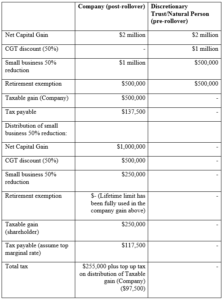
In essence, by using the company rollover has converted the unrealised gain on the business of $1.2 million from an exempt trust gain into a company taxable gain with an underlying tax liability on a subsequent sale of around $350,000.
Takeaway
A company rollover may appear simple and give the desired immediate result (nil tax restructure). However, it creates an underlying tax problem.
There are usually alternatives to get a better result. These include the use of the small business CGT concessions in Division 152, or an alternative that does not trigger a taxing event.
When considering a business restructure, contact one of our specialist solicitors for suitable options and expert advice.
By Domenic Festa (Accredited Tax Specialist and Chartered Tax Adviser)
NOTE: This article is for general information only and should not be relied upon without first seeking advice from one of our specialist solicitors.
The post Company Rollover – A Last Resort Option? appeared first on Rouse Lawyers.