Tuesday, December 4, 2018

Tis The Season to be Jolly…But Not Too Jolly At Your End of Year Work Functions

Whilst the end of year work function is a great time for your team and business to celebrate your successes for the year, remember that your function needs to run as a ‘work’ function, without breaching your workplace health and safety obligations, your Human Resources policies and other legal obligations that your business must comply with.

Businesses should take steps to minimise the risks at your end of year functions and educate employees about the expected standards of behaviour at such functions and have some key steps in place to prevent any issues from arising, or if they do, to properly manage them to avoid issues, claims and litigation and starting your New Year off with the wrong kind of bang!

If employees become intoxicated at your end of year function or engage in inappropriate or unruly behaviour, your business should have a plan in place to deal with that.

Remember that, as the employer, your business can be held vicariously liable for the conduct, or rather misconduct, of your employees, even at your end of year work functions that are off site and outside of normal business hours. It is therefore a good risk management practice to remind your employees of their obligations, whilst of course still encouraging them to celebrate their successes for the year and have a good time, but that this is a balancing act for everyone attending.


What should your business be doing to prepare for your end of year work function?

Before end of year functions

  • Make sure that your business has the necessary Human Resources policies in place to address issues that may occur at end of year functions, such as a Code of Conduct and relevant policies, including on workplace bullying, sexual harassment and discrimination and that these are current and up to date and available to employees.

  • Make sure your Managers, Supervisors and Team Leaders are aware of and know that they are expected to model your relevant Human Resources policies at your end of year function.

  • Nominate key Managers, Supervisors and/or Team Leaders to discretely supervise at the function and give them clear authority to act if they see inappropriate or unruly behaviour – for example, arranging to cease serving alcohol to an intoxicated employee, to having a discrete discussion with an intoxicated or unruly employee to leave and assist in getting them home safely, e.g. ordering and escorting them to a taxi.

  • Make sure that your business sends out a clear email message prior to any end of year work functions – to set the expectations of employees regarding their conduct and behaviour at the function – and that your Human Resources policies still apply at your end of year function and that employees are expected to comply and behave appropriately and within the normal boundaries expected at work whilst they attend end of year functions. Also prompt them make appropriate arrangements to get home safely at the end of the function.

  • Whilst there is no specific obligation to provide transport home to employees after your end of year function, you should take active steps to minimise the risk of injury to your employees by specifying the clear rules that apply at your function, arranging for their safe travel home, and if anyone requires assistance in getting home, have designated personnel at the function to assist in arranging taxis for employees.

  • Make it clear that any post-function activities or after parties are on an employee’s own time and at their own responsibility.


At the end of year function

  • Set clear start and finish times for your end of year function.
  • Take steps to ensure that there is responsible service and consumption of alcohol and sufficient food and non-alcoholic drinks for employees to enjoy at the function. Place limits on the supply of alcohol if necessary.
  • Ensure your designated Managers, Supervisors and Team Leaders work to prevent excessive drinking and inappropriate or unruly behaviour.
  • Utilise taxis to ensure everyone leaves the function safely and can head home safely after the function.

What if something goes wrong?

  • Act quickly and discretely:

    • If an employee is too intoxicated, send them home in a taxi straight away;

    • If your Managers, Supervisors and/or Team Leaders become aware of inappropriate or unruly behaviour they should take immediate steps to stop the behaviour.

  • Make sure your Human Resources policies are adhered to carefully. If an investigation needs to be conducted after the end of year function, make sure this occurs.

  • Finalise any investigation and implement any disciplinary action required in accordance with your business procedures.


If your business follows the above steps, your business and your employees should be able to enjoy a successful and incident free end of year function and your business can start the New Year off with the right kind of bang!

In the event you need assistance to prepare for your end of year function, or dealing with an incident that occurs, Rouse Lawyers is experienced in providing responsive legal advice to manage such functions, and any incidents and investigations to navigate and minimise the risks to your business.

The post Tis The Season to be Jolly…But Not Too Jolly At Your End of Year Work Functions appeared first on Rouse Lawyers.

Wednesday, November 14, 2018

Gift Card Laws to Change

Gift cards: the backup when you’re fresh out of ideas for that person who has everything.

Remember that time you excitedly went to cash in grandma’s birthday present, only to find you were a week too late? Well, this dilemma is soon to change.

The federal government have introduced new regulations that will require gift cards and vouchers to have a minimum expiry period of 3 years. The expiry date on the gift card will need to be prominently displayed. Certain post-supply administration fees will also be banned.

This change to the Australian Consumer Law will apply nation-wide and provide consistency for consumers, with some states such as New South Wales having already introduced similar laws. Failure to comply with the new laws will risk a fine.

The new regulations will take effect on 1 November 2019 and apply to gift cards sold from that date. Businesses selling gift cards and vouchers outside of New South Wales therefore still have time to prepare for these changes.

Unfortunately the regulations won’t apply to existing gift cards, so be sure to spend this year’s haul of Christmas presents by the expiry date on the card.

By Luke McKavanagh

The post Gift Card Laws to Change appeared first on Rouse Lawyers.

Thursday, November 8, 2018

What is a “Make-good”?

Many tenants under retail or commercial leases don’t realise the extent of their obligations once their lease comes to an end. De-fits and make-goods can be costly, so knowing your obligations before you sign your lease is key.


Make-good or de-fit?

Most leases say that once the lease ends, the tenant must leave the leased premises in a certain state.

There are many different terms that can be used, including ‘de-fit’, ‘make-good’, ‘refurbish’ or ‘redecorate’. The lease will detail exactly what needs to be done. This can include one or more of the following:

  • Leaving the premises clean, tidy and in good repair.
  • The removal of your fixtures, fittings, signage and equipment.
  • Repainting the premises and replacing floor coverings.
  • Reconfiguring the premises to its original layout.
  • Stripping the premises back to a bare base-shell.

Even if you’ve installed a $100,000 fit-out in excellent condition, you may still be required to remove it.

Landlords may sometimes allow you to leave the premises as-is, but this is not common and unless the lease says otherwise, it’s the landlord’s choice to make. They may be willing to grant you this concession if they believe the current fit-out is in good condition and would be a selling point to secure a new tenant. However, even though you may consider your fit-out to add value to the premises, a new tenant may want a different look and layout. This is especially so if the use of the premises may change, for example, from a cafĂ© to a clothing store.

Some landlords may be willing to accept a predetermined de-fit fee and handle the works themselves, saving you from carrying out the de-fit yourself. This should be discussed well in advance though.


Plan ahead

It’s essential to engage a solicitor to negotiate your lease before you sign it. Leases are always up for negotiation and a reasonable compromise can often be reached. Consider the following:

  1. The lease may require a ‘bare shell’ state. This could instead be changed to be the same state as back when the lease started. That means you would only need to re-alter any changes you’ve made during your time as tenant, saving you from removing anything installed before your lease started.
  2. Leases often refer to returning things to their ‘original condition’. Your interpretation of ‘original’ may be the condition when your lease started, but the landlord may consider it to mean before a previous tenant took over. For example, the landlord may expect you to remove the kitchen installed by the former tenant who you bought the business from. You should clarify the meaning of ‘original’ in the lease.
  3. Did the landlord give you a fit-out contribution when your lease began? You may wish to ask that your make-good won’t extend to removing anything the landlord paid for.
  4. Avoid the landlord having a broad discretion to direct you to do ‘any’ works they require. Try to narrow this down to a particular list of things.
  5. It’s good practice for you to take photos and make a written record of the state of the premises before or when your lease started. That can save an argument in the future about whether a door or wall was there or not.

Consequences of not complying

Failing to comply with your make-good obligations will entitle the landlord to a number of different options depending on your lease. These can include the landlord:

  • being entitled to treat anything left in the premises as abandoned, meaning they become the owner;
  • doing the make-good themselves and sending you the bill (and then suing you and any guarantors if the bill isn’t paid); and/or
  • continuing to charge you rent until the make-good is complete to their satisfaction.

Always remember the security bond or bank guarantee that you gave the landlord when you signed the lease. Leases often say that landlords only need to give this back once the lease ends and they are satisfied with your make-good. If you fail to do your make-good then the landlord could apply your security towards doing it themselves.


What if you’re a franchisee?

If you’re a franchisee then you have an extra set of considerations to take into account.

Franchisees often assume that their franchisor will purchase their business at the expiry of the franchise agreement and take over the lease, or pay the franchisee for their fixtures. A franchisor has no obligation to do this, unless expressly stated in the franchise agreement.

We often hear franchisees say “the franchisor will not want this shop to close – they will pay for our equipment”.  Then, franchisees discover that the franchisor does not want the shop. A franchisee should take this into account before deciding not to renew a franchise. Rarely will a franchisor pay market value for a business including a goodwill component. They may pay either the written down value for the equipment or market value but that will not be much. Equipment that cost a lot to install (in some cases hundreds of thousands) may only bring $5,000 when valued as second-hand equipment.

Some franchisees may be lucky and have a franchisor willing to purchase their business, take over their lease or perhaps purchase their second-hand equipment at its market value, saving the obligation to de-fit and make-good the premises.

If the franchisor doesn’t elect to do this, then your franchise agreement will generally require you to de-badge your premises when the agreement ends. That means all identifying features unique to the franchise system must go. Even though your landlord may be fine with you leaving the premises as-is, your franchisor may require the colour scheme, fit-out, and even layout, to be changed.


Takeaways

A de-fit and make-good can be expensive, therefore a little thought and planning at the right time is essential.


By Luke McKavanagh

The post What is a “Make-good”? appeared first on Rouse Lawyers.

Trust Splitting: Opportunities Remain!

On occasions, it is desirable to restructure the assets of a trust. The motivations for a restructure can include: succession planning, separating control of certain assets to different persons, separating passive investments from business activities, and separating different businesses.

For Queensland practitioners, these restructures can be implemented without triggering stamp duty by implementation in accordance with a particular process that is not covered by the dutiable categories.

The sticking point is CGT. Until 31 October 2008, a trust cloning exception existed in CGT events E1 and E2 where the terms and beneficiaries of each of the trust were the same.

After 31 October 2008, an alternative often contemplated was through a process of trust splitting, which on a basic level involves appointing a separate trustee for certain identified assets of the main trust. Such a process would be effective for CGT purposes provided the trust split did not cause the creation of a new trust in respect of the assets held by the separate trustee.

Of itself, a trust split does not have the same effect as trust cloning prior to November 2008 since a trust split simply involves having separate trustees of one trust, whereas a trust clone resulted in a separate trust.

Some practitioners implemented additional steps – excluding beneficiaries in respect of the split assets, limiting the right of indemnity of each trustee to the assets held by that trustee, and placing the power to change trustees in respect of the split assets in a different person. These additional steps raise the question of whether the split trust caused the creation of a new trust.

The issue is considered in the ATO’s draft Taxation Determination TD 2018/D3. It concludes that an arrangement that displays certain factors are considered by the ATO to result in the creation of a new trust. In our view, the key factors identified by the ATO are:

  1. the existing trustee is removed as trustee of certain assets and a new trustee appointed to hold those assets;
  2. control of the original trustee resides with certain beneficiaries, and the new trustee is controlled by other beneficiaries;
  3. different appointors for each trustee;
  4. the trustee’s right of indemnity is limited to the assets held by each trustee;
  5. distributions are limited to a subset of beneficiaries associated with the controller.

Various trust splitting arrangements can be implemented without incorporating these factors. In particular, arrangements separating passive investments from business activities and different businesses would only require factor number 1.


Case Study

Joe Ryan as the sole director and shareholder of Ryan Pty Ltd, the trustee for the Ryan Family Trust. The trust fund of the Trust includes a substantial professional services business, and a passive investment portfolio. Joe wishes to change the trust arrangements by placing the ownership and operation of the professional services business in a separate trustee company. Joe establishes Ryan Services Pty Ltd, removes Ryan Pty Ltd as trustee of the professional services business, and appoints Ryan Services Pty Ltd as trustee for that business. These changes are not covered by the draft tax determination and are not considered to create a new trust. In addition, if the indemnity of Ryan Services Pty Ltd were limited to the services business (where legally permitted), we also consider the arrangement is not covered by the draft tax determination.


Takeaway

The draft tax determination is limited in its terms to trust splitting arrangements evidencing particular features. Opportunities remain to implement trust splitting arrangements that are not covered by the draft tax determination.

Nevertheless, trust splitting involves appointing separate trustees of a single trust. For that reason, we consider trust splitting arrangements should be a last resort option and other available alternatives should be canvassed.


By Domenic Festa (Accredited Tax Specialist and Chartered Tax Adviser)

NOTE: This article is for general information only and should not be relied upon without first seeking advice from one of our specialist solicitors.

The post Trust Splitting: Opportunities Remain! appeared first on Rouse Lawyers.

Trust Splitting: Better Alternatives For Consideration

Trust splitting is a process that involves appointing a separate trustee for certain identified assets of a single trust. The purpose of a trust split is to separate the control and legal ownership of assets into separate trustees. The reasons for implementation include: succession planning, separating control of certain assets to different persons, separating passive investments from business activities, and separating different businesses.

They are viewed by some as a replacement for the trust cloning exception that existed until 31 October 2008. However, a significant disadvantage is irrespective of the number of separate trustees, there is a single trust – therefore it does not deliver the same benefits as a trust clone.

Some advisers had attempted to introduce additional steps into trust splitting to produce the same effect as a separate cloned trust. After the release of TD 2018/D3, all forms of trust splitting may be subject to challenge either because they are covered by the draft determination or by the application of what the ATO considers to be the law under its revised interpretation.

There are a number of alternatives for dealing with trust assets.


Trust Restructures

For Queensland clients, restructures can be implemented without triggering stamp duty by using a particular process that is not covered by the dutiable categories. Importantly, it does not require a clone with the same terms and beneficiaries, but merely a commonality of trust interests. It also allows a restructure from one type of trust into a different type of trust e.g. from a unit trust to a discretionary trust or a superannuation fund, and vice versa.

It is therefore possible to restructure trust assets into a different trust without stamp duty, and CGT can be addressed if eligible for one of the following alternatives:

  • Fixed/Unit Trusts – utilising the CGT rollover, if eligible, under subdivision 126-G.
  • No capital gain/sufficient available losses – despite a CGT event occurring, no tax liability will arise if there is no capital gain or any gain is offset by capital or revenue losses.
  • Small business CGT concessions – these concessions require satisfaction of active asset conditions and either $2 million turnover or $6 million maximum net asset value test requirements. If eligible, they can allow a restructure of a trust asset without tax and provide a market value cost base to the new trust.
  • Small business restructure rollover – this rollover is available for entities with active assets associated with small businesses with turnover of up to $10 million. It is a true rollover with the cost base of the new trust being the same as the existing trust (there is no upgrade as occurs under the Small business CGT concessions).

Family Splitting Arrangement

This is an alternative that provides much of the benefits of a trust restructure without triggering any CGT or duty events. It can be used to transfer the control among beneficiaries, or alternatively to separate the risk attached to each particular asset.

This alternative has the following elements:

  1. New entities (companies or trusts) are established as required:
  2. The current controllers can retain control over the existing trust and the new entities. Alternatively, they can pass control of the new entities to the separate beneficiaries at any time they choose;
  3. Current equity in the relevant asset is transferred to the identified new entity;
  4. The new entity takes a registered security interest over the relevant asset, providing it with control in respect of disposal of the asset;
  5. The new entity is provided with use and enjoyment of the asset;
  6. Protections are included to provide the new entity with future increases in the equity value of the relevant asset;
  7. Does not require the triggering of any CGT or duty event until the new entity requests the disposal of the asset.

The process allows a separation of trust assets not provided for by trust splitting, and done in a manner that does not trigger any CGT or duty events.


Case Study

Bruce Green as the sole director and shareholder of Green Pty Ltd, the trustee for the Green Family Trust. The trust fund of the Trust includes a substantial trading business, and a real estate portfolio. Bruce wishes to change the trust arrangements regarding the ownership and operation of the trading business in a separate trust. Bruce establishes Green Services Pty Ltd which is to act as trustee for the Green Business Trust. The Family Splitting Arrangement is implemented resulting in the future conduct of the business being operated by the trustee of the Green Business Trust, which is separate from the Green Family Trust. No CGT or duty events are triggered on the transaction.

Please contact one of our team for the options available to assist with trust rearrangements and trust succession.


By Domenic Festa (Accredited Tax Specialist and Chartered Tax Adviser)
NOTE: This article is for general information only and should not be relied upon without first seeking advice from one of our specialist solicitors.

The post Trust Splitting: Better Alternatives For Consideration appeared first on Rouse Lawyers.

ATO Attack on Stapled Structures: Does it Affect Private Business

The ATO has had on its radar what it describes as stapled structures. It has identified a number of concerns that it has with stapled structures. Then in the May 2018 budget, the Government announced amendments to the law to address some of the concerns.

In its Taxpayer Alert (TA 2017/1: Re-characterisation of income from trading businesses), the ATO identified four different kinds stapled structure arrangements. Each of those have similarities to structures that are commonly implemented by private business.

This article considers whether the ATO concerns apply to private business.

The kinds of staples identified by the ATO (in order of relevance to the private business) are: Royalty Staple, Rental Staple, Finance Staple, and Synthetic Equity Staple.

Further details in respect of each of the staple arrangements, and how they are similar to private business structures are:


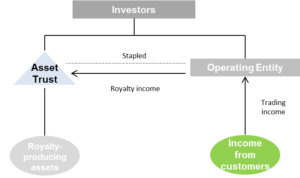
Royalty Staple

Key Features:

  • Asset Trust holds assets such as intellectual property, industrial equipment, or other assets of a busines
  • Operating Entity pays a royalty to Asset Trust for use of the assets
  • Operating Entity claims a tax deduction for the payments made to Asset Trust


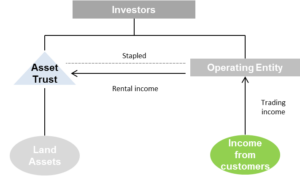
Rental Staple

Key Features:

  • Asset Trust owns land and fixtures on land (e.g. business premises)
  • Operating Entity enters into one or more lease agreements with Asset Trust for lease of the premises
  • Operating Entity claims a tax deduction for the payments made to Asset Trust


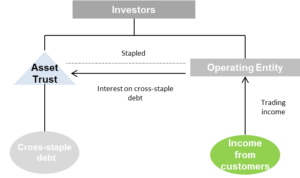
Finance Staple

Key Features:

  • Operating Entity carries on a business usually with external debt
  • Operating Entity carries much less than the expected level of equity
  • Asset Trust receives trust equity from the investors as beneficiaries
  • Asset Trust’s equity is lent to Operating Entity at interest
  • Operating Entity claims a tax deduction for the interest payments
  • The interest is usually distributed to the investors


Synthetic Equity Staple

Key Features:

  • Asset Trust and Operating Entity enter into an arrangement under which the Operating Entity pays:
    • profit-equivalent amounts to Asset Trust-
    • turnover-equivalent amounts to Asset Trust, and/or
    • amounts which have a similar result as the above.
  • Operating Entity claims a tax deduction for the payments made to Asset Trust


Each of the above staples have some equivalents to structures ordinarily implemented by private business entities as follows:

  1. Royalty Staple – License arrangements for a business;
  2. Rental Staple – lease of business premises;
  3. Finance Staple -inter-entity loans;
  4. Synthetic Equity Staple – license arrangements and certain kinds of joint venture agreements.

However, it seems clear from the Alert that the ATO’s key concern is where stapled structures are used with foreign investors, and the stapled structure converts income that would have otherwise been trading income in a corporate entity into more concessionally taxed passive income derived by a trust (in particular, an MIT). For foreign investors, trading income in a corporate entity is taxed as fully franked dividends at 30%, but passive income flowing through a trust is taxed at much lower rates applying to interest and royalties. Their main focus of attack is that the trust is not an MIT but rather taxed as a public trading trust, which prevents income from being concessional passive income.


Effect on Private Business Structures

Most private business structures are owned and controlled by Australian residents. The issue of concern with the ATO of the tax benefits to foreign investors from stapled structures do not arise for Australian residents in private business entities.

The ATO acknowledges that traditional stapled structures have been used in the tax system for many years and are accepted where they do not exhibit the above issues involving foreign investors.

However, they also note that stapled structures of the ordinary kind have general tax compliance issues to satisfy in their implementation. It is therefore necessary to ensure proper implementation with effective documentation.


By Domenic Festa (Accredited Tax Specialist and Chartered Tax Adviser)

NOTE: This article is for general information only and should not be relied upon without first seeking advice from one of our specialist solicitors.

The post ATO Attack on Stapled Structures: Does it Affect Private Business appeared first on Rouse Lawyers.

Wednesday, October 24, 2018

Effect of Trust Vesting Date: ATO Confirms Our Long-Held View!

Most trusts, and all private discretionary trusts, have what is known as a vesting date which is described differently in different trust deeds e.g. Vesting Date, Perpetuity Date, Termination Date, Vesting Day. The question often asked is what happens when that day is reached? This issue is considered by the ATO in Taxation Ruling TR 2018/6 Income tax: trust vesting – consequences of a trust vesting.


The Issue

Many practitioners believe that on reaching that day the trust comes to an end and essentially requires a winding up process: realise such of the assets as are necessary to pay out liabilities, pay liabilities, and transfer the surplus assets are those that are entitled. In private discretionary trusts, the trustee will have a discretion to nominate which of the beneficiaries are entitled to surplus.

Clearly this is an issue for many practitioners, resulting in the ATO issuing a public ruling.

The concern is that the sale of assets and transfer of surplus assets to beneficiaries will trigger liabilities for capital gains tax and stamp duty, based on the market value of the assets at the time of the transfer. Bearing in mind the perpetuity period is often 80 years, these liabilities can be significant.

This belief arises because it is generally understood that the life of a trust is limited by a perpetuity period (often set as a period of 80 years prescribed by statute), and at the end of that period the trust must come to an end.


Legal Concept

The concept of a perpetuity period is founded in what is described as the ‘rule against perpetuities’. That rule is described in Jacobs’ Law of Trusts in Australia 8th edition in the following way:

In its modern formulation, as stated in Cadell v Palmer, it provided that an interest in property if not vested at the time of its creation, must vest [within the perpetuity period]; if there was merely a possibility that this might not occur, the disposition was void. It will be observed that the rule is not strictly a rule against perpetuities, but against remoteness of vesting.


Solution

The writer has always taken the view that the rule requires that the interests in the trust become fixed, with proper processes the trust does not come to an end, and a trust may exist in perpetuity provided it vests (with fixed interests in nominated beneficiaries) within the perpetuity period. The result is that with proper processes capital gains tax and stamp duty liabilities can be avoided on the vesting date.

Capital Gains Tax – relevant CGT events for consideration are CGT events A1, E1, E5 and E7. By adopting the proper process, there is no transfer of assets, beneficiaries do not become absolutely entitled to the assets, and the other CGT events will not apply.

Transfer (Stamp) Duty – this applies if there is a transfer of dutiable property or a change of trust interests. By adopting the proper process there will be no transfer or such a change.

In Taxation Ruling TR 2018/6, the ATO considers the income tax consequences of reaching the vesting date. Consistent with our view above, the ATO states in paragraph 13:

The vesting of beneficial interests in a trust, even if described as a ‘Termination Date’, does not  ordinarily cause the trust to come to an end, nor cause a new trust to arise. Vesting does not mean trust property must be transferred to the takers on vesting on the vesting date, or that the trust must be wound up either immediately or within a reasonable period (although the deed may require these events to occur after vesting).

Upon the vesting of a discretionary trust, the interests of entitled beneficiaries become fixed, and the trust converts from a discretionary trust to a fixed trust. Various restructures of either the trust assets or the vested interests may be considered which do not trigger liabilities for capital gains tax and/or stamp duty.


Takeaway

When considering these issues it is prudent to use advisers that are fully aware of the legal ramifications, and do not need to wait for ATO guidance.


NOTE: This article is for general information only and should not be relied upon without first seeking advice from one of our specialist solicitors.
Contact one of our specialist solicitors to address your trust vesting issues.
By Domenic Festa (Accredited Tax Specialist and Chartered Tax Adviser)

The post Effect of Trust Vesting Date: ATO Confirms Our Long-Held View! appeared first on Rouse Lawyers.